
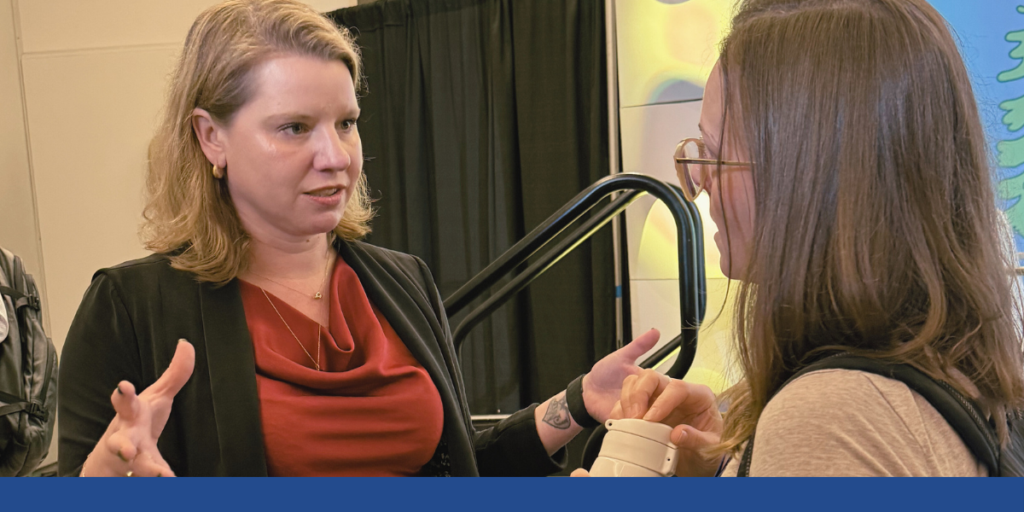
Relay GSE CEO Dr. Sarah Johnson at SXSW EDU 2026 on what it actually takes for AI to transform education at scale.
There is no shortage of AI tools being built for education right now. What remains scarce is a disciplined focus on whether those tools actually improve teaching and learning for educators and students in real classrooms.
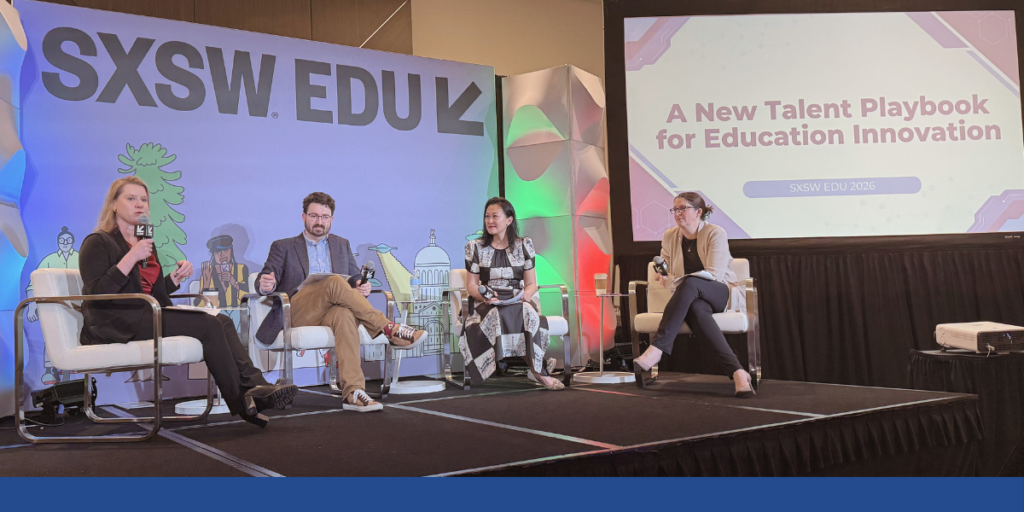
That was the core argument Dr. Sarah Johnson, President and CEO of Relay Graduate School of Education, brought to SXSW EDU 2026. Joined by leaders from the Walton Family Foundation, Valhalla Foundation, and Renaissance Philanthropy, Sarah made the case for something the ed-tech sector rarely centers: educators as partners in innovation, not just users of new technology.
A loom automates. A crane augments.
Sarah opened with a metaphor that reframes how we should think about technology in education.
Too much EdTech focuses on automation, making existing processes faster or cheaper. But the real opportunity, Sarah argued, is augmentation: strengthening the work educators already do and expanding what they are able to accomplish with students.
Companies like Google, OpenAI, and Anthropic will build powerful tools, and some of them will be impressive. But without educator partnership embedded from the start, even the most powerful AI risks doing the opposite of what the field needs: fragmenting learning instead of coherently supporting it.
At Relay GSE and Teaching Lab, this question is central to our work. We exist across the full arc of an educator’s career, from the classroom to school and system leadership, which means we see firsthand what happens when innovation arrives without the instructional infrastructure to support it. Tools get adopted and abandoned. Coaching doesn’t scale. Districts manage a growing stack of disconnected products that don’t connect to the work teachers are actually trying to do.
Students absorb the cost of that fragmentation. What the field needs is not a better tool — it’s a different approach to building them, one that starts with educators and ends with students getting the education they deserve.
A loom automates something a human can do. A crane does something a human cannot do on their own.
– Dr. Sarah Johnson
What this looks like in practice
Every tool we develop at Teaching Lab Studio starts with a problem educators have named. Educators are embedded in the development process from the beginning: designing alongside our team, testing in real classrooms, and shaping how the product evolves based on what teachers actually experience.
That process is slower than shipping a product to the market. It is also why tools like Nisa, Coteach, and EnlightenAI are different from what the broader market produces are built to work within the instructional systems educators operate in every day.. They are not built for teachers. They are built with them, inside the instructional systems where they need to work.
“If we want educators to actually engage in this augmentation type of work, you need to build their trust and you need to, in context with them, make sure that you’re innovating in a way that actually meets their needs.”
That trust is not incidental to the process. We’ve seen it compound: educators who are partners in building a tool are also the most effective advocates for using it — and for integrating it meaningfully into teaching and learning.
Our partnership with Anthropic: A model for what’s possible
Teaching Lab partnered with Anthropic on an AI benchmarking project that brought educators and AI researchers together around highly technical work. The two groups did not share a common language at the start. By the end, a Teaching Lab educator was a co-author on the resulting paper, which went on to win an award.
Sarah named this at SXSW as the kind of partnership the field needs more of. It is a small story with a large implication: when educators are treated as intellectual partners rather than end users, the work gets better for everyone and that is what moving innovation from a pilot into a system actually looks like.
That is what it takes to move innovation beyond pilots and into systems where it can improve learning at scale. That’s the model we’re building toward, across every tool that comes out of Teaching Lab Studio and every partnership we bring to school systems.
Ready to bring this work to your district?
Teaching Lab partners with school systems and mission-driven organizations to build what’s next in teaching and learning — with educators at the table.