
Most AI tools for schools promise to save teachers time. Dr. Sarah Johnson says districts should expect more.
District leaders are hearing a familiar set of promises about AI: faster lesson planning, easier communication, less paperwork, and more time in the day. Those gains can matter, especially in systems where teachers are already carrying a lot.
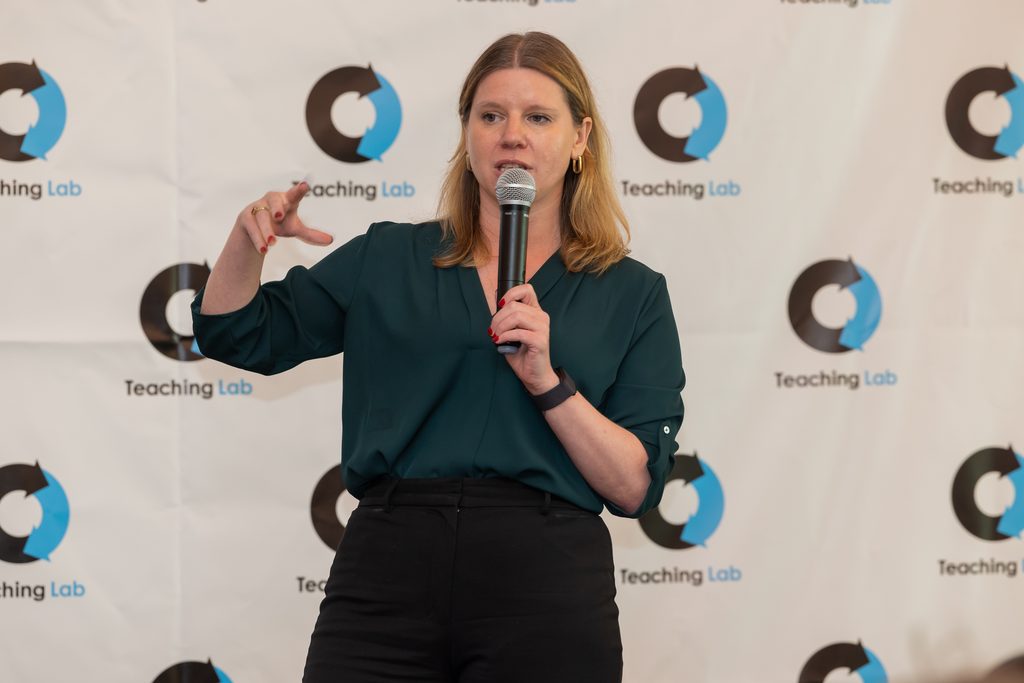
But at a recent Overdeck Family Foundation event on strengthening the teaching profession, Sarah Johnson, President and CEO of Relay Graduate School of Education, urged leaders to look beyond efficiency alone. She offered a sharper question for evaluating any AI tool: Does it raise the floor, or does it raise the ceiling?
For Sarah, the distinction gets at a central challenge for school systems. High-quality coaching, feedback, and opportunities to practice are often limited by time, staffing, and the number of expert people available. The question is not simply whether AI can complete a task. It is whether it can make meaningful support more available to teachers while preserving the professional judgment and relationships that make that support effective.
The real constraint is access, not time.
Ask what actually helps a teacher get better, and the answer has not changed in decades: frequent feedback, time to practice, and a clear read on what students understand. What has changed is whether it is possible to offer those things to every teacher.
For most of education’s history, it hasn’t been. Expert support is rationed by how many coaches a district can hire and how many hours they have in a week. New teachers feel that shortage most.
A ceiling-raising tool changes that math. It makes possible what Sarah describes as conditions that have never existed at scale: a teacher who gets feedback every day, a chance to rehearse a lesson before students see it, and real-time insight into what students understand, paired with a clear next step.
Why this matters more than the tool itself
Tool adoption alone is not a sufficient measure of success. Districts need evidence that educators find a tool useful, that it fits their work, and that it contributes to stronger practice and better opportunities for students. The floor-versus-ceiling test is useful precisely because it doesn’t depend on the tool. It depends on what happens to the person using it. A district evaluating any AI product can run it through the following questions:
- What is this actually giving teachers access to that they didn’t have before?
- And does it still require a human to be good at their craft, or does it try to replace that craft?
- Would teachers choose to use it if no one required them to?
- How will this fit within the systems we already have?
These questions shift the conversation from purchasing technology to strengthening a system of support.
How Teaching Lab Studio works with districts and educators
Sarah is direct about where Teaching Lab lands on that second question. Tools built at Teaching Lab’s Studio, which the organization launched about three years ago, are built directly with the teachers and students who will use them, and none are scaled until there’s evidence they work and evidence that teachers actually want to use them. That second bar, teachers choosing to use a tool rather than being required to, matters as much to Teaching Lab as the impact data itself.
That same principle shapes who gets a say in what Teaching Lab builds in the first place. The organization’s Teacher Advisory Board exists so that educators aren’t reviewing finished products after the fact, they’re shaping the tools while they’re still being built. It’s the same philosophy Sarah described on stage, applied upstream of the product itself.
One is NISA, an AI-enabled coaching tool that keeps a human coach in the loop by design. Rather than replacing instructional coaches, it helps them extend what they already do to more teachers than they could reach alone, without losing the relationship that makes coaching work in the first place.
The other is a teaching simulator, which uses AI to let teachers practice before they’re ever in front of students and get feedback on whatever they’re working to improve. Sarah connects this directly to the evidence base on how teachers actually develop: more deliberate practice leads to faster growth. The simulator is one way to make that kind of practice available at a scale no single coach’s calendar could match.
A partnership begins with the district’s question
For school systems considering AI, the first conversation should not be about a product demonstration. It should begin with the support gap the district is trying to close.
Whether the need is to extend coaching capacity, create more opportunities for practice, or help teams respond more effectively to student learning, Teaching Lab Studio partners with districts to understand the local context and determine whether an evidence-informed approach is the right next step.
The most promising uses of AI in education will not be measured by novelty or adoption alone. They will be measured by whether educators have stronger support to improve their practice and whether students experience better learning as a result.
Want to work with a team that builds this way? Get in touch and let’s talk about what raising the ceiling could look like for your teachers.